
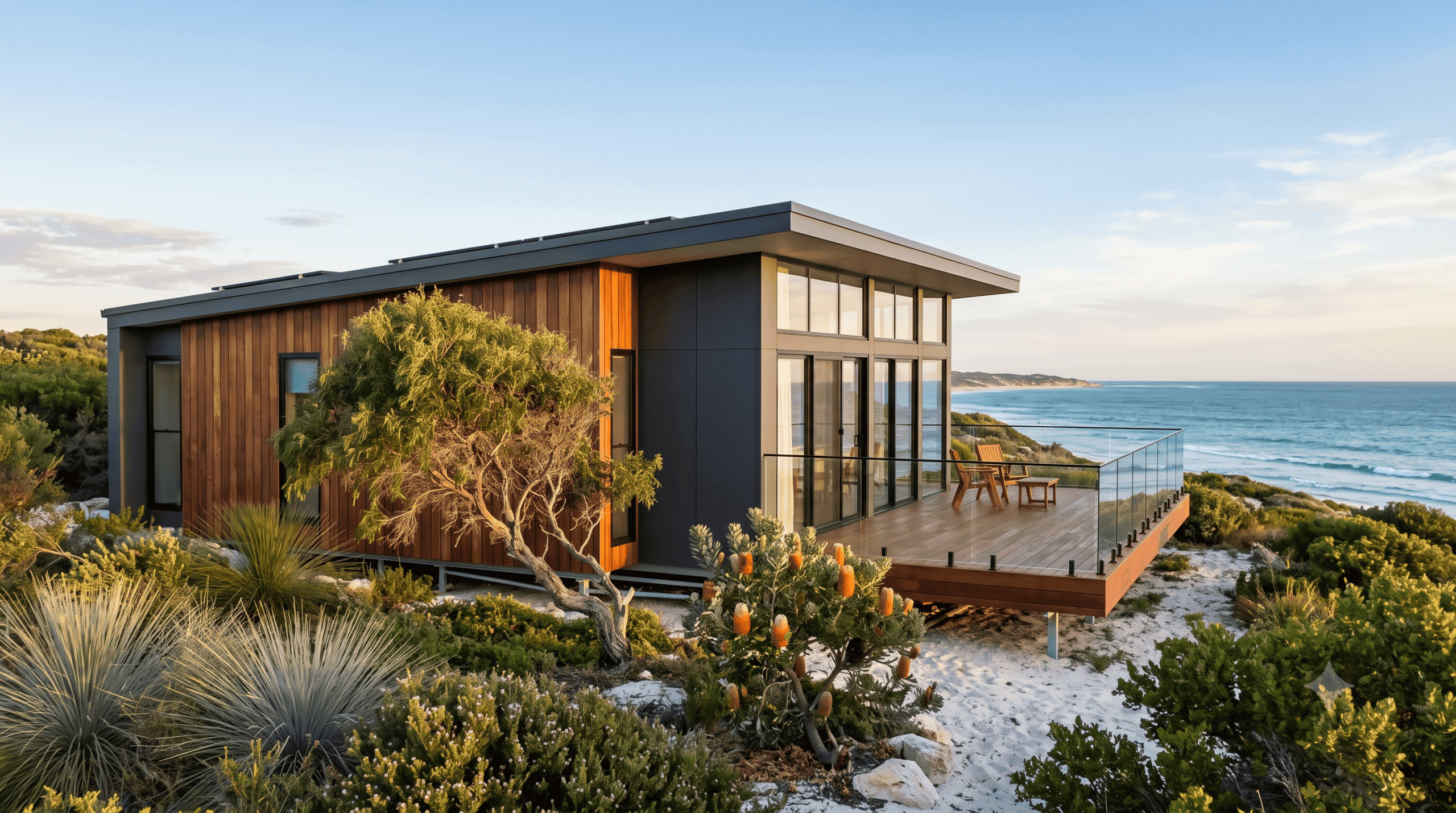
Western Australia’s coastline is one of the most compelling places to build a new home. The light is different here, the pace is different, and the connection to the outdoors shapes the way people want to live. Whether you are planning a permanent residence, a family retreat or a home suited to retirement living, a coastal modular home gives you a practical path to building in some of the state’s most sought-after regional locations.
Modular construction suits coastal areas well. Most of the build takes place off-site in our Western Australian manufacturing facilities, meaning your home is protected from prolonged weather exposure during construction and arrives at your block largely complete. Combined with careful material selection and site-specific engineering, this process helps our clients build with confidence in environments that demand more from a building.
Designing for the Coast
Coastal living is about more than the view. The best coastal homes feel open and connected to their surroundings, with layouts that bring in natural light, capture breezes and make the most of outdoor spaces.
A modern coastal style works with simple building forms, calm colour palettes and textured external finishes. Whites, soft creams and muted tones sit well against natural coastal landscapes, while horizontal cladding profiles echo the horizon and give the facade a relaxed, contemporary character. Inside, open spaces and generous glazing keep rooms light and connected to the environment outside.
When the site allows, we position living areas to capture views and daylight while placing bedrooms and service areas for privacy. Covered verandas and outdoor areas extend the usable space and create places for families to gather and enjoy the outdoors year-round. Orientation, layout and the indoor-outdoor relationship all influence how practical a home is to live in day to day, and we consider them together from the start of every project.
Why Material Selection Matters More Near the Ocean
Coastal areas place real demands on a building. Salt carried through the air settles on roofing, cladding, fixings and external hardware. Combined with strong winds and moisture, unsuitable materials can deteriorate significantly faster than they would in sheltered inland locations.
The level of salt exposure varies between properties. Australian standards require varying degrees of corrosion protection for homes constructed within 10km of breaking surf or within 1km of non-surf coastline, such as sheltered bays or estuaries. The requirements are most stringent within 1km of breaking surf, where the environment is classified as severe marine.This is where we need to start considering construction upgrades such as using COLORBOND® Ultra coated steel (instead of regular COLORBOND®) – along with other corrosion considerations such as hot dip galvanised coating systems. Understanding where your block sits within these distances is an essential part of planning a durable coastal home.
We review these conditions early so that material selections, protective coatings and structural details are all designed to your property’s actual exposure. Treating coastal durability as an afterthought, once drawings and selections are finalised, is one of the most common and costly mistakes in coastal construction.
Cladding and External Walls
External walls are the most visible element of a coastal home and one of the most important for durability. The right cladding needs to suit both the design intent and the environmental conditions of the site.
Fibre cement and cement composite products are an excellent choice for coastal modular homes. They resist moisture, salt erosion and the thermal movement that causes natural timber to warp over time. Horizontal weatherboard profiles in fibre cement deliver the classic coastal aesthetic without the high maintenance demands of real timber, and can be finished in any colour that suits the coastal landscape.
COLORBOND® Ultra also provides additional protection beyond standard, and depending on proximity, your build may require additional coating & fixing systems for corrosion protection too.
For properties with severe exposure, we assess the complete wall system, including fixings, junctions and component compatibility. One unsuitable detail in an otherwise well-specified wall can become a failure point over time. Our team reviews external claddings and finishes as a complete system, not a list of individual product selections.
Roofing, Gutters and Metal Components
Steel roofing and walling products perform well across the Australian climate, but standard coatings are not appropriate for every coastal environment. COLORBOND® Ultra steel is designed for severe marine conditions and may be specified for roofing, gutters, fascias and downpipes on properties where proximity to saltwater and exposure category make it the right choice. For very severe coastal environments, a more specialised steel specification may be required.
Corrosion is not limited to visible roofing. Structural connections, screws, balustrade components, door hardware and window fittings are all potential weak points if unsuitable grades are used. Marine-grade stainless steel is commonly used for external balustrades and exposed fixings in coastal locations because of its greater resistance to pitting corrosion.
We assess roofing, flashings, fasteners and all external metal components together to ensure the complete building envelope works as a coordinated system. A home built to withstand coastal conditions needs every detail considered, not just the most visible ones.
Engineering for High Winds
Properties near the coast are frequently exposed to strong winds, particularly on elevated blocks or sites with limited shielding from surrounding structures or vegetation. Wind classification is assessed per property and cannot be assumed based on location or distance from the water alone.
The wind classification result influences roof framing, tie-down requirements, window systems, external doors and large openings. Verandas, decks and other outdoor structures also require specific engineering to handle local wind loads safely. These requirements are determined by a structural engineer in line with Australian standards, including AS4055, and feed directly into the design and specification of your home.
We bring wind engineering into the design process early so that structural decisions are resolved alongside the layout and exterior style, not retrofitted as compromises later. For exposed sites, thoughtful placement of outdoor areas, covered entries and protected courtyards can also make a genuine difference to everyday comfort.
Modular Construction in Coastal Regions
For clients building coastal modular homes in regional Western Australia, the modular process offers a practical advantage. Because major sections of your home are constructed off site in our manufacturing facilities, the build is not subject to the weather delays, trade availability issues and extended site exposure that affect traditional construction in remote or coastal locations.
Our homes use fully engineered steel frames and reinforced prestressed concrete floors as standard. Modules are assembled under consistent supervision, with quality checks completed before transport. By the time your home is delivered and installed, the structure, walls, roofing and internal fitout are already complete to a confirmed standard.
This suits coastal regions particularly well, where site access, local trades and weather windows can all affect how a traditional build progresses. Modular homes offer a more predictable process with fewer variables on-site.
Energy efficiency is built into the process. Insulation, glazing and orientation are decided during drafting and can be tailored to the coastal environment. Solar panels and other sustainability features can be incorporated during engineering, subject to roof orientation and client priorities.
Maintenance and Longevity
Even well-specified coastal homes require regular maintenance to ensure longevity. Salt accumulates on external surfaces, hardware and sheltered areas that do not receive adequate rain washing. Left unaddressed, this can void product warranties and accelerate the deterioration of components that were correctly specified at build.
A six-monthly wash-down of external walls, windows, doors and exposed metal components is recommended for homes close to the ocean. Regular inspections for early rust or coating breakdown allow small issues to be caught before they become expensive repairs. We provide a clear maintenance guide at handover so clients understand exactly what is required to protect the home’s performance over the long term.
Built for Western Australia
Modular WA began as a small family business and has grown into one of Western Australia’s established modular builders. Our founding director Wayne McGrath’s family history in prefabricated housing spans around 30 years, and that experience carries through into every coastal project we take on.
We have delivered homes across Western Australia’s most demanding coastal environments, from the Gascoyne and Pilbara coastlines to the South West and the Great Southern. Each project gets the same focus: honest communication, practical decisions and a home that suits the lifestyle and landscape of where it will stand.
Our standard plans are adaptable and can be developed into a custom layout where needed. Rooms, outdoor areas and storage can all be adjusted within module and transport constraints to suit a growing family, a couple seeking a quieter coastal lifestyle or buyers exploring retirement living options near the water.
Frequently Asked Questions
Are coastal modular homes suitable for severe marine environments?
Yes, provided the design, engineering and materials are matched to the property’s actual exposure. We assess salt exposure, wind classification and site access early to confirm the right approach before design begins. Suggested coastal proximity upgrades include: COLORBOND® Ultra or Stainless Steel, marine-grade fixings, interpon/Hot Dip Galvanisation (HDG) Coating Systems, and considering timber external structure members.
Do coastal builds cost more than standard modular homes?
Coastal specifications can carry additional costs depending on your home’s distance from the marine environment, exposure severity and required materials. We identify those costs during the initial block review so there are no surprises at the contract stage.
Can I get a modern coastal design with a modular home?
Yes. Our plans can be designed to a contemporary coastal aesthetic, including horizontal cladding profiles, open plan living, large glazed openings and covered outdoor areas. Custom layouts are also available.
How do I know which materials are right for my block?
It depends on your distance from breaking surf, wind exposure and the surrounding environment. We review those details as part of our standard site assessment before recommending a specification.
What maintenance will a coastal modular home require?
Regular cleaning of external surfaces and inspection of metal components. Frequency depends on proximity to the ocean and the products specified. We provide a clear maintenance guide at handover.
Start with a Conversation About Your Block
Building a coastal modular home in regional Western Australia involves more decisions than a standard build, but with the right preparation, it does not need to be a difficult process. The key is getting the site assessment, material selection and design right from the beginning.
We offer a free, no-obligation block review covering access, coastal conditions, engineering requirements and a realistic picture of what is possible on your land. Speak with our team today.
